
I have this thing that I do with home decorating that I didn’t realize wasn’t a popular thing until I mentioned it recently to a few friends. You see, I have a habit of floating furniture in pretty much any room I can get my hands on. I don’t know why I do it; I just do. And I like it.
Let me take a step back for a second.
What do I mean by ‘floating furniture’?
I’m not sure if it’s even a technical term. My guess is it’s not; I’ve been known in my day to make up words and phrases. I use the term ‘floating furniture’ to denote a design scheme where furniture is not adhered to the walls like this:
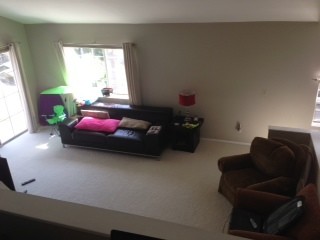
(Photo Credit: Houzz)
Floating your furniture simply means that you place pieces off the wall, sometimes in the middle of the room. By doing this, you create the illusion of having more space and you make your room more inviting.
Don’t get me wrong, having your couches, chairs, tables, etc. up against your walls isn’t a bad thing. It’s just not something I tend to do and I have good reason for it.
To explain, I’ve got to roll it back a few years to a subdivision in the suburbs of Syracuse, NY <insert dream sequence here>.
I lived in a new housing subdivision where houses were built with four blueprints in mind. It wasn’t uncommon to find that your neighbor’s house is the exact same style house as yours. That’s exactly what happened to me. My next door neighbor had the same house, different exterior color. *Sigh* My husband and I moved in and within a week our neighbors were chomping at the bit to get a glimpse of the changes we made. Call it …friendly curiosity.
My neighbor, who had the exact same house layout as me, walked into my foyer, looked at the living room to the left and exclaimed “Oh! Your living room feels so cozy. I LOVE IT!”
We had the same living room. I had no idea what she was talking about. In my opinion, there was only one logical way to set this living room up. I couldn’t understand how my living room could be any different that hers save, maybe, the color scheme.
I learned the following weekend that we didn’t have the same house at all. Structurally, of course, they were exactly the same. Our living rooms were both in the same location in the house. Both rooms were 12’x24′ with a fireplace on the far end and an opening to both the foyer and the dining room. The windows were in the same place. We even had the same amount of furniture including a loveseat, a full size couch, a chair and an ottoman. But still, these rooms were nothing alike. The difference? They had all pieces plastered up against every wall. The couch and the loveseat were on separate walls and were so far away from each other that it made conversation awkward. Also, the natural flow of traffic was right through the middle of the room, which meant that anyone passing by would walk right in the middle of the conversation. In all, the room was uncomfortable and looked discombobulated.
My husband and my living room, conversely, looked like this: 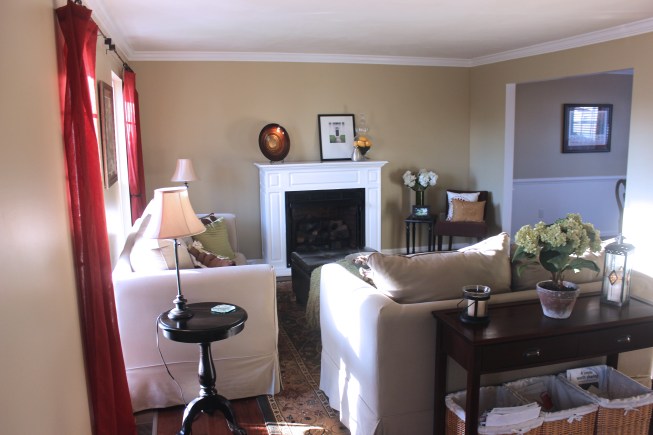
You may not be able to tell from the photo, but the loveseat, the sofa table, and a few other miscellaneous items are floating a few feet off the wall. In fact, I’m only using 2/3 of the space in my living room. There is a natural walkway behind and next to the loveseat that doesn’t require cutting off someone’s conversation as you pass through. Also, the couches and chair are so close to each other that you can have a casual conversation without being forced to yell.
And I think this works.
What I found from my neighbors’ house is that they designed in fear. They more or less told me so. I believe their exact words were “I would never be brave enough to put the furniture in the middle of the room like you did.” They went on to explain that it was awkward to find a way to make a long/narrow living room feel cozy and not too small. Their solution was to slap their furniture on any solid wall in the provided space.
Fear was driving their furniture against the wall.
I find a lot of people do this with small spaces. They see a small room or an awkward layout and feel that in order to make it feel larger they should place the furniture as far away from each other as possible. Nay, I say! Doing that only makes the room feel smaller, awkward and disjointed.
Think of it like this – when your furniture is floating in the room you open up space around it, which tricks the eye into thinking there’s a lot more room than there actually is. Also, by floating your furniture you decide the design/layout of the room instead of allowing the architecture to force it for you.
Take my new living room in Rhode Island. First, let me tell you that popular opinion agrees the room is small. Like, tiny. Like, holy whoa, it’s 12’x15′ with an archway in the middle, an entire wall taken up by a closet and a bedroom door, and no hallway/walkway built in. Oh, and one of the walls faced the water, so it was important to capitalize on that. I saw this space before we moved in and I nearly had a panic attack. I only had two walls to anchor the furniture but I couldn’t use them because it drew the room away from its best feature – the harbor view.

To save myself from a dysfunctional living room, I did what I only know how to do – I floated the furniture. I could see a physical cringe from my husband when I told him my ideas. I knew he wanted to trust me, but he didn’t believe me. He knew the space was small, and his intuition told him that if I were to place the furniture in the middle of the room it’d make an already small room feel smaller.
So I did what any self-respecting wife would do and I ordered the furniture online and set up the living room before he got home from work. I’m a firm believer in asking or forgiveness rather than for permission when it comes to things like this. Sometimes seeing is believing.
I have to say that it came out exactly how I envisioned. It also provided that which I’d aimed to achieve – comfort. There’s no doubt the space is small, but in my opinion, it feels more cozy than cramped. It’s hard to see in this photo (once again a reminder that I need to purchase a wide angle lens!) but absolutely no furniture is up against a wall. Everything is floating. The couch, the chairs, the floor lamp – everything. 
I did the same thing last week in our dressing room. You see, this house we’re living in is so small that our bedroom can’t fit all of our bedroom furniture. That said, we (read: I) decided that the middle bedroom would be a dressing room and we’d treat it like a big closet. I’ve been struggling with the design of that room for a very long time. Like, a year and some change. I recognized about a month ago that I hated this room because every piece of furniture was pushed against the wall. I’d gone against my own philosophy. Ah!
I remedied that by buying an “anchor” piece to float in the middle of the room. It was a large, round, storage ottoman – because it makes sense to throw a large item in the center of an already small room. In fact, I’m pretty sure my husband disliked me for days after I bought it. You learn to pick up on those cues after a few years together.
There was a lot of huffing every time he walked into that room. There were a few “this thing is right in the middle of the room!” and “…not exactly practical…” spouts from time to time. I even think I caught an eye roll in my general direction. Or maybe I made that up. But I’ll give it to him – despite his hesitation, he never once told me to get rid of it.
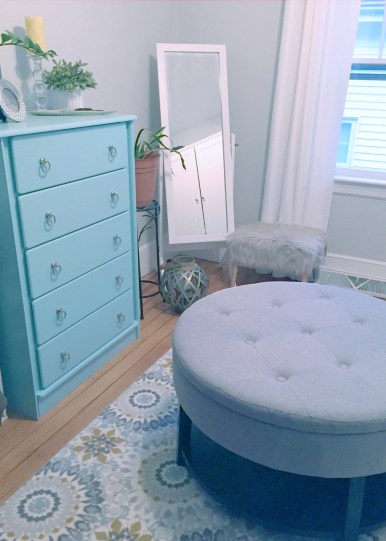
Regardless, the piece finished the room and it finally looks complete! Use your imagination with this one because (dang it!) I’m still waiting on that wide angle lens, but putting the ottoman in the center of the room helped to anchor the space. My husband even admitted days later that the ottoman was pretty convenient. It gave us a place to store our extra linens, it allowed us a place to sit to put on our shoes or whatnot, and it complemented the area rug on which it sat. Wife for the win!
While I’m clearly a huge proponent of floating furniture, there are some things you must consider when you travel down that avenue. I’ve listed some of the considerations I recommend you think about that will (hopefully always) guarantee success when you float your furniture.
Keep your furniture to scale
With the exception of my giant storage ottoman (above), which was – I’ll admit – an experiment, I purchased the rest of the house furniture with the specific room in mind. Think back to my living room. If you didn’t notice immediately, the couch is actually a loveseat and the two chairs are small accent chairs. If I tried floating a full size couch in there, it would have spanned the entire room and it would be incredibly awkward to walk around it. Likewise, if I used some deep, overstuffed upholstered chairs in lieu of the small(er) accent chairs, you could kiss the cozy goodbye. It’d feel cramped because frankly, it would be.
Grab the measuring tape, get realistic measurements of the totalspace you have to work with, as well as the maximum size of furniture (including depth/height) and then do your furniture research/shopping from there. A small space recommendation is to go to Overstock.com or Wayfair.com for a great selection of apartment-size pieces.
Choose a layout with flow
Part of choosing to float your furniture involves creating a room within a room. There’s a lot of power behind that, but it also leaves a lot of gray area in which you can screw it up.
To me, a “room with flow” means that there is a clear path to navigate to the living area and a clear path to go in/out. The room makes sense without needing explanation. Also, a room with flow is naturally comfortable. If it’s a living room, it’s conducive to conversation. If it’s a bedroom, it’s evoking a sense of relaxation. If it’s a dining room, it’s calling for a family to gather or party.
Whenever I decide the way a room will flow, I first walk into the room and decide where the focal point is. In my Syracuse living room, it was the fireplace. In my Rhode Island living room, it’s the harbor view. In my family room, it’s the TV. And in the dressing room, it’s actually the floating furniture itself (y’know. The experiment). When I figure out the focal point, I then consider the rest of the room. Place your most comfortable furniture facing the focal point. Then, place your accent furniture in a way that creates an imaginary (conversation) circle. This could mean that your furniture faces each other like I’ve done with my living room. It could mean that the furniture makes an “L” shape. Or, like my living room in Syracuse, it could even mean that your furniture physically makes a circle.
I’ve found that when a room looks comfortable for conversation, it instantly feels inviting, warm and larger than life. Try it!
Pay attention to area rugs/textiles
One thing I’ve found is that if the area rugs aren’t the proper size for the room, it makes floating furniture look ridiculous. Remember back when I mentioned the “anchor” piece in my dressing room? Yeah, well, I firmly believe that every room should have something anchor it. Most of the time I rely on my area rugs to do so. It’s just easier that way.
But, what is the proper size for an area rug? Funny you should ask. I can tell you from my own mistake in the very same RI living room you saw a photo of earlier, the wrong size rug ruins a room. Not shown in the picture is the first rug I had in there; a 4’x6′ area rug that was too small for all the furniture to touch it. I swapped it out for a larger rug where every item was completely on the rug. Perfection!
In a room that “floats” I find it important for the rug to be large enough where the furniture actually touches the rug. That goes for living rooms as much as it does for bedrooms and dining rooms. I’m just going to throw at you a diagram, written by a home stager from Atlanta, GA named Kathy Nielson. She created a diagram to help you choose the proper size rug. This one shows the living room, but the principles work on other rooms, too.
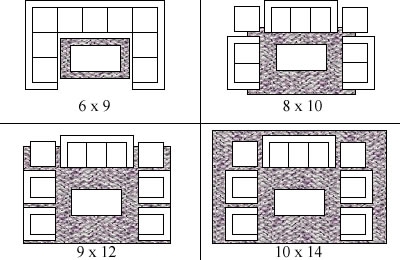
And, this might be a great time to tell you that you can always place an area rug as an anchor over a carpet. Trust me, it works.

Floating your furniture can be a fun experiment to change up the look and feel to any room in your house. Make sure you pay attention to a few key details mentioned above to ensure your room maintains character without being confusing.
What design tips do you rely on for your home decorating?
 simplyrhody.com